Habitat
High-elevation cloud forest and humid montane forest, usually in forest edge and canopy movement corridors.
Best observation window
Early morning (roughly 5:45-8:30 AM) is usually most productive for flock detection.
Species profile
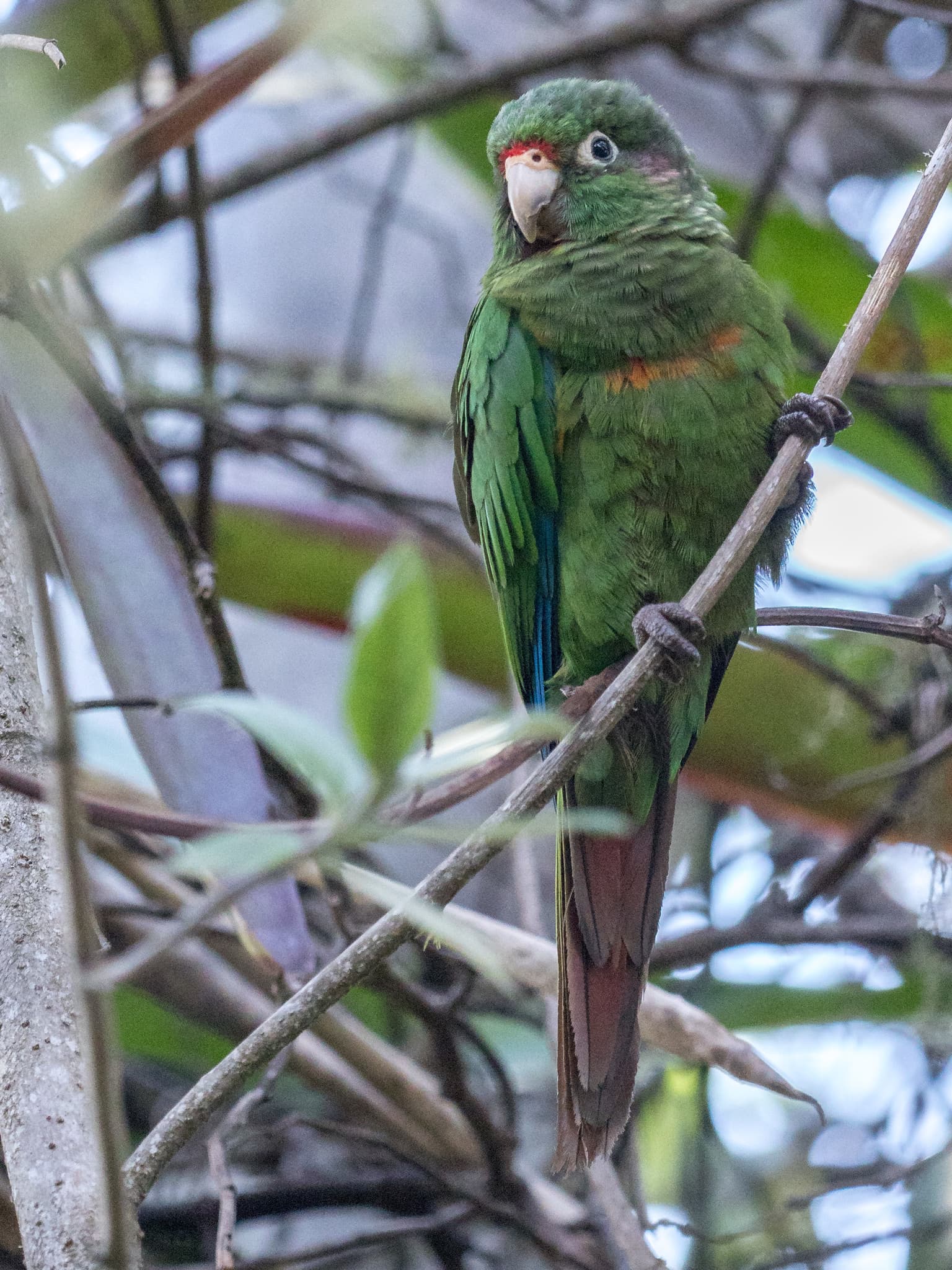
Pyrrhura viridicata
One of the flagship endemics of the Sierra Nevada de Santa Marta, this medium-sized green parakeet typically moves in noisy flocks and is often detected by voice before being seen clearly. It is a priority species for local conservation programs because it depends on remaining montane cloud forest blocks.
Signature behavior: Usually detected in noisy moving flocks; vocal contact calls are often the first clue.

Photo: Wikimedia Commons (see author/license). Source
High-elevation cloud forest and humid montane forest, usually in forest edge and canopy movement corridors.
Early morning (roughly 5:45-8:30 AM) is usually most productive for flock detection.
IUCN status: Endangered (EN). Primary risks in the region include habitat loss, fragmentation, and land-use change.
IUCN status source: https://en.wikipedia.org/wiki/Santa_Marta_parakeet
El Dorado Reserve and nearby mountain forests above Minca
Elevation: high-elevation · Difficulty: moderate
Guide: recommended · Likelihood: strong · Timing: early-morning
San Lorenzo ridge routes with early-morning guide departures
Elevation: high-elevation · Difficulty: hard
Guide: guide-required · Likelihood: strong · Timing: dawn-only
Minca upper elevations during active feeding windows
Elevation: mid-elevation · Difficulty: easy
Guide: casual-ok · Likelihood: good · Timing: flexible